


Dosing pumps are precision pumps designed to deliver controlled volumes of chemicals into a process stream to meet quality, safety and performance requirements. Global Pumps offers a broad range of dosing and metering pump solutions in Australia built for water treatment, food and beverage production, mining and industrial processing.
What Is a Dosing Pump?
A chemical dosing pump injects exact volumes of liquid chemicals into a process at a controlled rate. Unlike standard transfer pumps, dosing pumps are engineered for accuracy and consistency rather than high flow. They are commonly used for pH control, disinfection, chemical treatment and process conditioning.
What Is Chemical Dosing?
Chemical dosing is the controlled addition of a specific quantity of chemical into a system over time. It ensures the correct concentration is maintained for treatment, cleaning, neutralisation or process control. Accurate chemical dosing reduces waste, improves efficiency and supports compliance.
How Do Dosing Pumps Work?
Dosing pumps operate using the positive displacement principle, moving a defined volume of liquid with each stroke or rotation. This allows operators to deliver accurate and repeatable chemical dosing regardless of pressure changes within the system.
The dosing rate can be adjusted by controlling pump speed, stroke length or electronic input signals to achieve precise and repeatable dosing.
Common operating mechanisms include:
Peristaltic design – Rotating rollers or shoes compress a flexible hose, trapping and advancing fluid through the pump in a continuous, valve-less flow path. This design isolates the fluid within the hose, making it ideal for abrasive, corrosive or sensitive chemicals.
Diaphragm metering – A reciprocating diaphragm acts as an oscillating displacement element, alternately drawing a defined volume of liquid into the pump chamber through an inlet check valve before forcing it out through a discharge check valve. This mechanism enables accurate dosing independent of system pressure variations.
Many dosing systems integrate with sensors and control platforms for automated, real-time dosing adjustments.
Types of Dosing Pumps
Different types of dosing pumps are designed to suit specific fluids, pressures and dosing requirements. The most common technologies used in industrial chemical dosing applications are diaphragm metering pumps and peristaltic dosing pumps.
Diaphragm Metering Pumps
A diaphragm metering pump represents the concept of high-pressure precision, utilising a reciprocating diaphragm and a series of check valves to move clean, low-viscosity liquids with high precision. These pumps are widely used in water treatment and chemical processing where energy efficiency and pressure handling are top priorities.
Because the displacement is mechanically controlled, diaphragm pumps maintain stable flow rates even against fluctuating discharge pressures. This makes them a reliable solution for controlled chemical injection in stable process environments.
Peristaltic Dosing Pumps
Peristaltic dosing pumps are built on the concept of a continuous, seal-less flow path. Fluid is captured within a flexible hose and moved forward by rotating rollers, allowing the pump to handle a wide range of media - from delicate polymers to abrasive slurries - with ease.
This design eliminates internal valves and seals, reducing the risk of vapour lock or valve clogging while simplifying maintenance to a single wear component: the hose.
This valve-less, straight-through flow allows peristaltic pumps to handle suspended solids and off-gassing chemicals while maintaining reliable prime across a wide range of viscosities.
Within this category, two main variations are used:
-
Peristaltic Tube Pumps: Optimised for high-precision, low-pressure applications (up to 4 bar). They use non-reinforced tubing and rollers for a gentle action, making them suitable for laboratory, food processing and micro-volume chemical dosing.
-
Peristaltic Hose Pumps: The heavy-duty version using reinforced multi-layer hoses and rotating shoes inside a lubricated casing. These pumps are designed for abrasive slurries, high-solids content and demanding industrial environments, with discharge pressures reaching up to 16 bar.
Are Dosing Pumps Necessary?
Dosing pumps are necessary when chemical accuracy directly impacts safety, quality or performance.
Manual chemical addition can result in:
- Inconsistent concentrations
- Increased chemical waste
- Higher labour requirements
- Greater operator exposure risk
Automated dosing improves reliability and control.
Do I Need a Dosing Pump?
You likely need a dosing pump if your process requires:
- Consistent chemical dosing
- Automated process control
- Reduced operator handling of hazardous chemicals
- Regulatory or audit compliance
- Measurable and repeatable results
Dosing pumps improve precision, reduce waste and support safer operations.
How to Use a Dosing Pump
To operate a dosing pump effectively:
- Select the correct pump type for the chemical.
- Set the required flow rate or dosing volume.
- Calibrate the pump to confirm accuracy.
- Integrate with sensors or control systems if required.
- Perform regular inspection and maintenance.
Proper setup ensures consistent dosing performance and extended pump life.
What Is the Best Dosing Pump?
The best dosing pump depends on the fluid properties, pressure requirements, dosing accuracy and level of automation needed for the application.
At Global Pumps, several Verderflex models are commonly recommended for their reliability and performance in industrial dosing systems:
- Verderflex Ds500: Best for Fast, Tool-Free Servicing
The Ds500 is designed to simplify maintenance with a “click-and-go” cartridge system. The entire pumping element can be replaced in seconds without tools, significantly reducing downtime compared with traditional metering pumps.
- Verderflex Rapide Series: Best for Compact Industrial Installations
The Rapide is a rugged, plug-and-play tube pump suited to industrial dosing systems and skid-mounted installations where space is limited but reliability is essential.
- Verderflex Dura and Verderflex VF Hose Pump Series: Best for Abrasive or High-Pressure Applications
These heavy-duty hose pumps are widely used in mining and wastewater treatment. Their vertical design improves heat dissipation and extends hose life when handling abrasive slurries or high-pressure processes.
- Verderflex Vantage 5000: Best for Smart Automation & Connectivity
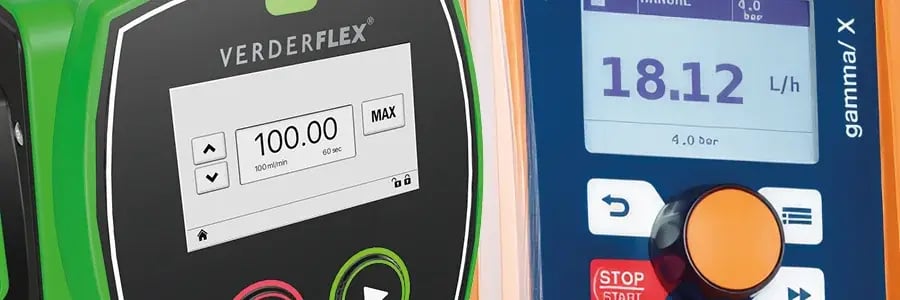
The Vantage 5000 is designed for advanced dosing systems, offering touchscreen control, programmable dosing profiles and seamless integration with SCADA and automated process systems.
Selection should consider chemical compatibility, flow rate range, pressure requirements, automation needs and maintenance preferences.
Related Case Studies
Reagent Dosing Pump at a Major Australian Mining Site
A Victorian gold and antimony mining operation required a reliable reagent dosing pump to accurately deliver hazardous chemicals at 200 mL/min without leakage in a harsh 24/7 environment. Following on-site assessment, Global Pumps recommended the Verderflex Ds500 peristaltic dosing pump for its high metering accuracy, interchangeable tube cartridges and user-friendly controls. The result was consistent, leak-free performance, reduced chemical exposure in hazardous areas and lower maintenance requirements - prompting the site to consider standardising the Ds500 across additional dosing applications.
Read the full case study for more details.
Chemical Dosing for Egg Washing
A Queensland egg grading facility supplying Sunny Queen needed to reduce chemical waste and labour costs in its egg washing process, where sodium hydroxide and anti-foam are required to meet Australia’s mandatory cleaning standards. The previous manual dosing system relied on timed pumps and frequent QA testing, resulting in high chemical consumption and limited audit visibility. Global Pumps supplied and installed 10 Ds500+ smart dosing pumps with automated tracking and sensor integration, delivering precise, programmable chemical control. The upgrade reduced chemical overuse, improved dosing accuracy and simplified compliance reporting, resulting in an estimated $85,000 in annual savings.
Read the full case study for detailed project outcomes.
Dosing and metering pumps provide precise chemical control across water treatment, food production, mining and industrial applications. By selecting the correct dosing pump type, operators improve safety, reduce waste and maintain consistent process performance.
For high-accuracy chemical delivery and automated integration, chemical dosing pumps are an essential component of modern process systems.