


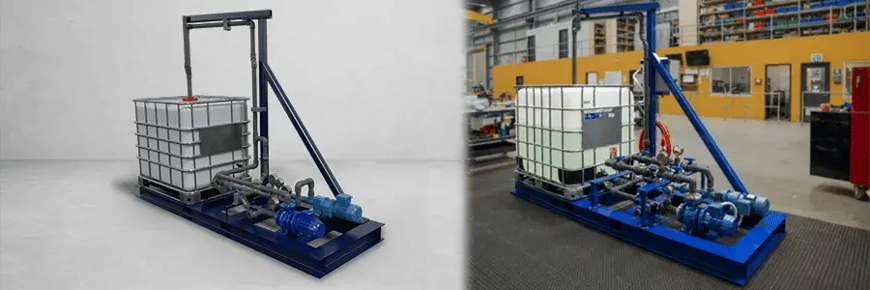
Global Pumps designed and built a custom dual pump training skid for an industrial manufacturing client, combining a centrifugal pump and a helical rotor pump on one portable, fully assembled system. The skid lets apprentices safely compare both pump technologies and learn how a complete pumping system operates.
CHALLENGE SOLVED AT A GLANCE
Application: Dual pump apprentice training for industrial manufacturing
Challenge: Train apprentices safely on real pump technologies.
Solution: Global Pumps designed a skid-mounted centrifugal and helical rotor pump system with integrated pipework, valves, instrumentation, and controls.
Outcome: Fast, low-disruption commissioning, safe side-by-side pump comparison, and a reusable training platform apprentices can learn on from day one.
Rather than supplying a single pump, Global Pumps recommended a skid-mounted system so trainees could compare the two pump types most commonly found across manufacturing and processing plants, while learning how a complete pumping system (pipework, valves, instrumentation, and controls) operates as one unit.
Global Pumps pre-assembled and pressure-tested the entire system in its Adelaide workshop before delivery, so installation was limited to connecting the power supply and process lines. This made the skid well suited to training environments where equipment needs to be commissioned quickly and moved between workshops or production areas as programs require.
Why use a dual pump system for industrial manufacturing training?
Manufacturing apprentices need to recognise and operate both major pump technologies used across plant utilities and process lines. Global Pumps designed the skid so trainees could compare both, side by side, on one platform.
- The centrifugal pump demonstrates higher-flow transfer of low-viscosity liquids: the type used in cooling water, general process water, and utility transfer systems.
- The helical rotor pump shows how thicker or solids-containing fluids, such as oils, lubricants, or process slurries, are moved at a controlled rate. It's a positive displacement technology common in dosing, waste transfer, and viscous fluid handling applications.
Training on both, side by side, gives apprentices a clearer understanding of pump selection logic before they ever work on live production equipment.
How the system works
- Liquid is stored inside an IBC (Intermediate Bulk Container).
- Factory-installed pipework, fitted by Global Pumps, connects the IBC to both pumps.
- The operator selects either the centrifugal pump or the helical rotor pump.
- The selected pump transfers the liquid through the system.
- The flow meter displays the flow rate during operation.
- Non-return valves prevent liquid flowing backwards through the pump that isn't operating.
- Once pumping is complete, isolation valves allow either pump to be serviced safely, reflecting the lockout/isolation procedures used on live plant equipment.
System components
Global Pumps specified and fitted every component on the skid to work as a single, integrated system.
Liquid transfer
|
Feature |
What it does |
Why it's useful |
|---|---|---|
|
Fully plumbed IBC connection
|
Connects the IBC to both the centrifugal and helical rotor pumps
|
Reduces on-site pipework. Connect power and process lines, then commission
|
|
Centrifugal pump
|
Uses a rotating impeller to move low-viscosity liquids
|
Mirrors pumps used in plant cooling and process water transfer systems
|
|
Helical rotor pump
|
Uses a rotor and stator to move thicker or solids-containing liquids
|
Demonstrates positive displacement principles used in oil, lubricant, and slurry transfer
|
|
Manual pump selection
|
Lets the operator choose Pump 1 or Pump 2
|
Allows direct, side-by-side comparison of both pump types
|
Pump protection and flow control
|
Feature |
What it does |
Why it's useful |
|---|---|---|
| Suction and discharge isolation valves | Isolate each pump from the system | Enables safer servicing without shutting down the whole skid |
| 12 mesh suction strainer | Removes larger debris before it reaches the pumps | Protects internal pump components from damage |
| Non-return valves | Allow flow in one direction only | Prevent backflow through the idle pump |
| Flow meters | Measure flow through the system | Lets trainees monitor and compare pump output |
Control and safety
|
Feature |
What it does |
Why it's useful |
|---|---|---|
| Custom-built control panel | Starts, stops, and controls both pumps | Centralises all operating controls in one location |
| Emergency stop | Shuts down the complete system immediately | Provides a fast response in an emergency, matching plant safety expectations |
| Padlockable main isolator | Disconnects main power and can be locked off | Supports lockout/tagout procedures used across manufacturing sites |
| Plug-and-play motor connections | Connect motors using industrial three-phase plugs | Allows pumps to be removed for servicing without disconnecting hard wiring |
| 20 m three-phase power cable | Supplies power to the complete skid | Adds flexibility when positioning the unit on the workshop or plant floor |
Skid construction
|
Feature |
What it does |
Why it's useful |
|---|---|---|
| Forkliftable base plate | Allows the skid to be moved with a forklift | Makes relocation around training facilities or production areas easier |
| Fabricated painted skid | Holds pumps, valves, controls, and instruments on one steel frame | Arrives assembled and ready for use, minimising commissioning time |
Looking for a custom pump skid?
Whether the application is a training system, a process skid, or a complete pump package for manufacturing, industrial, or processing use, Global Pumps can design, assemble, and test a custom skid-mounted pump system to suit the requirement.
Contact the Global Pumps team to discuss the next custom pump skid project.