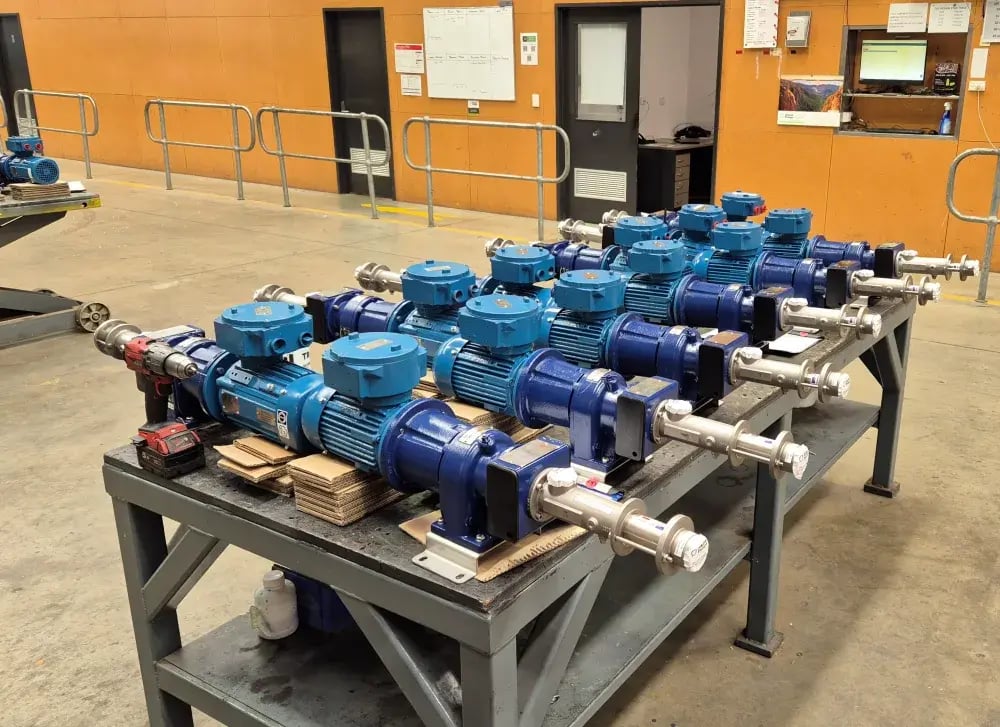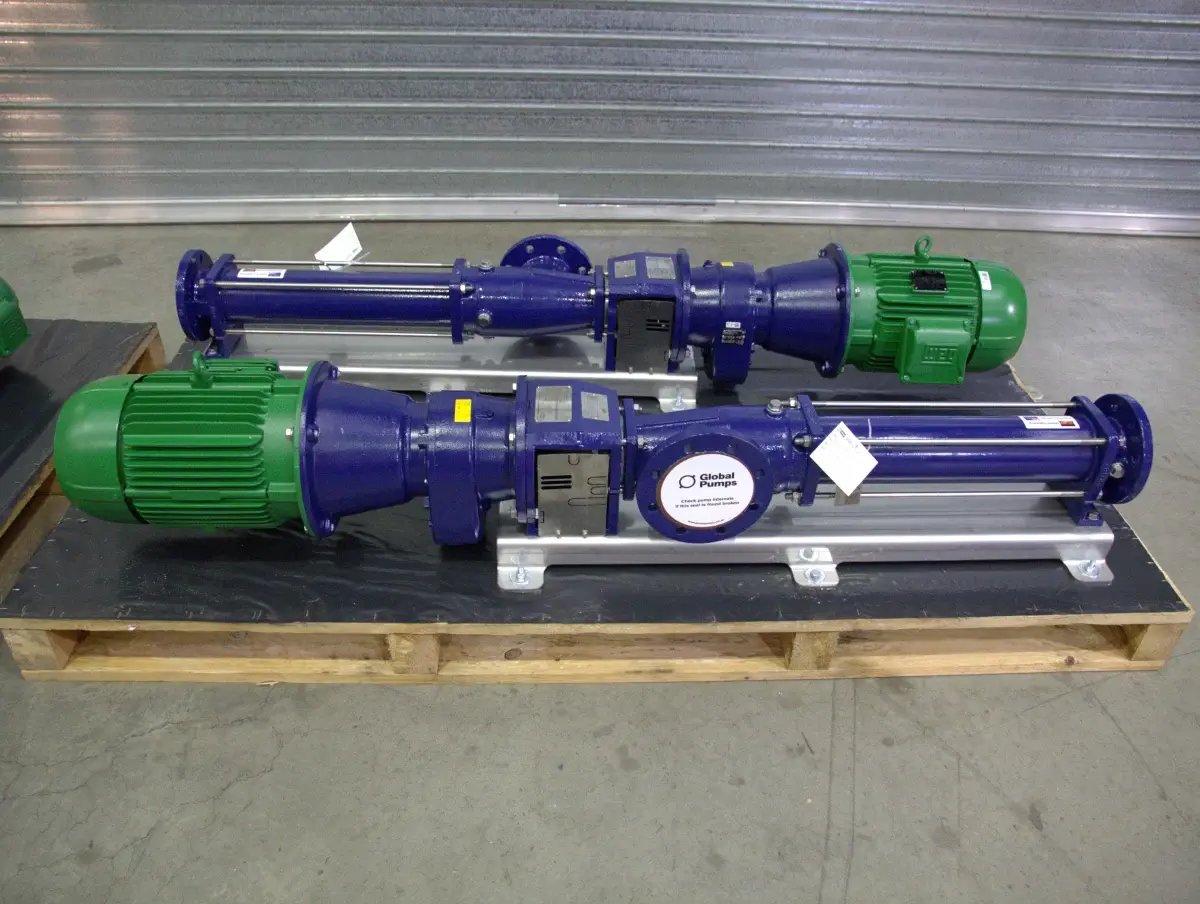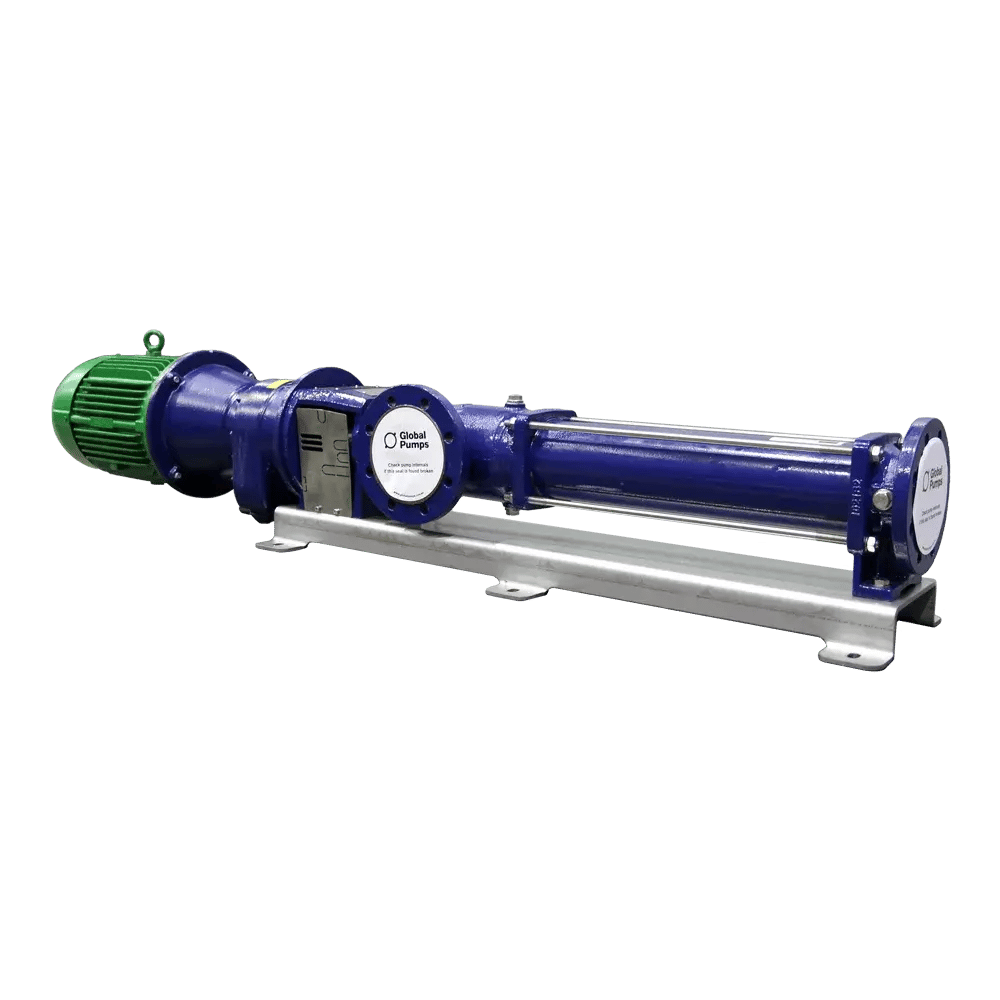
Progressive cavity pumps (also known as helical rotor pumps) provide accurate, low-pulsation transfer of liquids, slurries, pastes and semi-solid materials across a wide range of industrial applications. Using a helical rotor and stator pumping principle, they deliver smooth, consistent flow with gentle product handling, making them ideal for shear-sensitive, abrasive, viscous, corrosive or solids-laden media.
Key features of Toro progressive cavity pumps
Progressive cavity pumps are designed to provide reliable, low-pulsation pumping for a wide range of difficult fluids, from low-viscosity liquids through to highly viscous, abrasive and solids-laden media. Their positive displacement design ensures accurate, consistent flow while gently handling shear-sensitive products, making them suitable for transfer, dosing and metering applications across many industries.
Progressive cavity pumps can be configured to suit a wide operating envelope:
| Performance area | Typical range |
| Conveying capacity | 0.06 L/h to 500 m³/h |
| Differential pressure | Up to 96 bar |
| Temperature range | -20 °C to +180 °C |
| Suction lift capability | Up to 9 m |
Final pump selection depends on the product being handled including viscosity, solids content, pressure, temperature, duty point, installation conditions and material compatibility.
These progressive cavity pumps are particularly well suited to applications where conventional pump technologies struggle, offering reliable performance with:
Faster maintenance. Less downtime. Lower life cycle costs.
For applications where uptime and maintenance access are critical, Toro progressive cavity pumps can be supplied with Smart Conveying Technology.
This innovative design features a two-part stator and quick-release rotor arrangement, allowing wearing components to be replaced without removing the suction or discharge pipework. Maintenance can often be completed by a single operator using standard tools, helping minimise downtime and reduce whole-of-life maintenance costs.
For even faster servicing, these pumps are available with an optional Smart Seal Housing.
This sectioned seal housing provides direct access to the mechanical seal and drive-side joint without dismantling the suction casing or connected pipework. This simplifies routine maintenance, reduces service time and helps protect the mechanical seal during drive-end repairs.
Standard progressive cavity pumps are designed for general industrial transfer duties involving low to high viscosity fluids, with or without solids. They deliver uniform flow, low shear, reversible operation, strong self-priming performance and multiple installation options.
Typical capability:
Progressive cavity metering pumps provide accurate, repeatable dosing for low to highly viscous products. They are ideal for corrosive, solids-containing and shear-sensitive media, delivering precise flow with minimal pulsation for chemical dosing and process control applications.
Typical capability:
Open hopper progressive cavity pumps are designed for highly viscous, paste-like and semi-solid materials with poor flow characteristics. An open hopper and integrated auger feed screw continuously feed product into the pumping element, ensuring reliable transfer of difficult media.
Typical capability:
Semi-submersible pumps are designed for pumping from tanks, pits, basins, containers and barrels. They are suited for abrasive or corrosive fluids ranging from low to high viscosity and can be customised to suit different immersion depths and installation requirements.
Typical capability:
Progressive cavity pumps operate on the positive displacement principle using a single helical rotor that rotates within a moulded elastomer stator. As the rotor turns, a series of sealed cavities are formed between the rotor and stator.
These cavities progressively move the fluid from the suction inlet to the discharge outlet at a smooth, consistent flow rate. Because the fluid is conveyed through sealed cavities rather than accelerated by an impeller, the pump produces low-pulsation flow with minimal shear, helping to protect delicate products and maintain process consistency.
This operating principle makes progressive cavity pumps well suited to handling viscous, abrasive, solids-laden and shear-sensitive media, as well as fluids containing fibres or entrained air.
Progressive cavity pumps are versatile and well suited to a wide range of industrial applications across Australia, including:
A progressive cavity pump is a positive displacement pump that uses a helical rotor turning inside an elastomer stator to move fluid through sealed cavities. This design provides smooth, low-pulsation flow and is ideal for viscous, abrasive and solids-containing fluids.
There is no functional difference. The terms progressive cavity pump, helical rotor pump, and progressing cavity pump are commonly used interchangeably to describe the same pumping technology.
They are suitable for low to extremely high viscosity fluids, slurries, sludge, pastes, adhesives, chemicals, oils, food products, wastewater, and products containing solids, fibres or entrained air.
Yes. Progressive cavity pumps are self-priming and can achieve suction lifts of up to approximately 9 metres, depending on the pump configuration and application.
Yes. Their flow rate is directly proportional to pump speed, making them an excellent choice for accurate dosing, metering and chemical injection applications.
Below is a guideline of how long it takes to shop products to Australia’s capital cities. We deliver Australia-wide, and can advise of anticipated lead time during the quoting process. If the order is urgent, we will act quickly to ensure you receive your peristaltic hose pump ASAP.
| Locations | Shipping time frame |
| Melbourne | 1-2 days |
| Sydney | 2-3 days |
| Brisbane | 2-4 days |
| Perth | 2-4 days |
| Adelaide | 1 day |
| Kalgoorlie | 3-5 days |
| Mt Isa | 3-5 days |